
BHMS in India: Fees, Eligibility, Top Colleges & Career Options
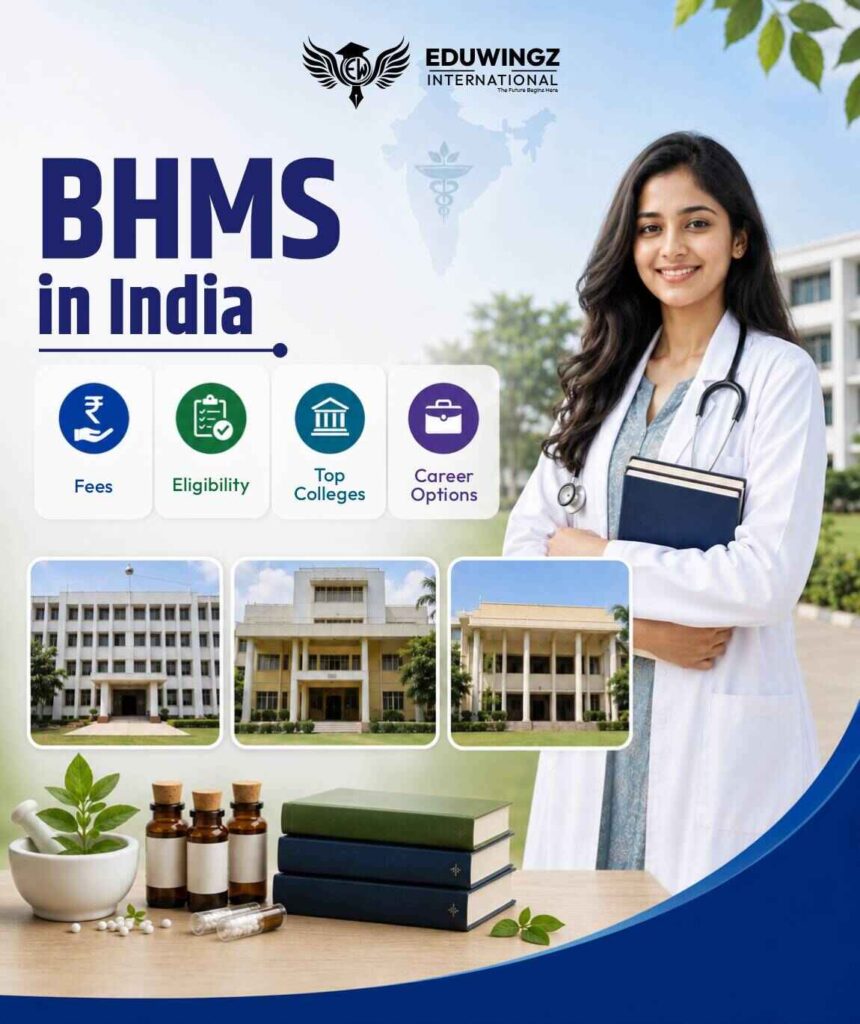
BHMS – Bachelor of Homeopathic Medicine and Surgery, is a five-and-a-half-year undergraduate medical degree regulated by the National Commission for Indian System of Medicine (NCISM). It is one of the most pursued AYUSH courses in India, attracting students who want a recognised medical qualification and a career in holistic, natural healthcare.
If you scored between 200 and 480 in NEET and are exploring alternatives to MBBS, this page gives you everything you need to understand BHMS in India, from eligibility and fees to top colleges, NEET cut-offs, and career scope.
Quick Answer: BHMS is a 5.5-year AYUSH medical degree in Homeopathy. It requires NEET qualification, offers government seats from ₹20,000/year, and opens careers in clinical practice, hospitals, research, and pharmaceuticals. |
What Is BHMS? A Clear Definition
BHMS stands for Bachelor of Homeopathic Medicine and Surgery. It is an undergraduate professional degree in Homeopathic medicine, equivalent in structure and duration to BAMS (Ayurveda) and BDS (Dentistry). The degree is awarded after completing 4.5 years of academic coursework followed by a 1-year mandatory internship at an approved clinical facility.
BHMS graduates are registered medical practitioners under the Central Council of Homoeopathy (CCH) and can practise independently as licensed physicians in India.
Key facts about BHMS in India:
- Duration: 5.5 years (4.5 years academic + 1-year internship)
- Governing body: National Commission for Indian System of Medicine (NCISM)
- Entrance exam: NEET UG (mandatory for all admissions)
- Counselling body: AACCC (central seats) + State AYUSH Councils
- Total BHMS seats in India: approximately 13,000+ across government and private colleges
- Degree type: Undergraduate professional medical degree
BHMS Eligibility Criteria in India
Before applying for BHMS, every student must confirm they meet the admission requirements set by NCISM and the respective state authority.
Academic Eligibility
- Passed Class 12 (10+2) from a recognised board
- Compulsory subjects: Physics, Chemistry, and Biology (PCB)
- Minimum aggregate: 50% in PCB for General/EWS category
- Minimum aggregate: 45% in PCB for SC/ST/OBC/PH candidates
- English as a subject in Class 12 is mandatory
Age Requirement
- Minimum age: 17 years as on December 31 of the admission year
- No upper age limit (as per the latest Supreme Court ruling)
Entrance Exam Requirement
NEET UG qualification is compulsory for BHMS admission in India. There is no alternative route, private universities, deemed institutions, and NRI quota seats all require a valid NEET score.
Important: Students who did not appear for NEET or who scored below the qualifying cut-off are not eligible for any BHMS seat in India, regardless of their Class 12 marks. |
BHMS in India Fees - Complete Breakdown
The cost of completing BHMS in India varies significantly based on the type of institution. Government college seats are highly subsidised, while private colleges charge full commercial fees.
College Type | Annual Tuition Fees (Approx.) | Total Course Fees (5.5 yrs) |
Government BHMS Colleges | ₹20,000 – ₹80,000 | ₹1.5 – ₹4.5 lakhs |
Private BHMS Colleges | ₹1.5 – ₹3.5 lakhs | ₹8 – ₹20 lakhs |
Deemed Universities | ₹2 – ₹4 lakhs | ₹11 – ₹22 lakhs |
Management Quota Seats | ₹3 – ₹5 lakhs | ₹16 – ₹28 lakhs |
Note: Fees listed above are approximate and subject to annual revision by the respective state fee regulatory committee. Hostel, mess, and miscellaneous charges are additional and typically range from ₹80,000 to ₹1.5 lakhs per year.
Students from economically weaker sections can apply for an education loan under the Government of India’s Vidya Lakshmi Portal. Several nationalised banks offer loans covering full BHMS fees without collateral for amounts up to ₹7.5 lakhs.
NEET Cut-Off for BHMS Admission in India
The NEET cut-off for BHMS is the minimum score and rank required to secure a seat in government or private homeopathy colleges through AYUSH counselling. Cut-offs change every year based on the number of applicants, seat availability, and difficulty level of the NEET paper.
Approximate NEET score ranges for BHMS admission:
- Government BHMS colleges (General category): 400 – 480 marks
- Government BHMS colleges (OBC/SC/ST): 300 – 380 marks
- Private BHMS colleges (General category): 250 – 380 marks
- Private BHMS colleges (OBC/SC/ST): 180 – 280 marks
- Management quota seats (private): 200 – 350 marks (institution-specific)
NEET Qualifying Cut-off for BHMS: General/EWS – 50th percentile | SC/ST/OBC – 40th percentile | PH (General) – 45th percentile. These are qualifying marks, not admission cut-offs. Actual admission cut-offs are higher depending on seat availability. |
Students with NEET scores between 250 and 400 should evaluate both government and private BHMS colleges carefully. The right college choice depends on location, fee budget, clinical infrastructure, and hospital attachment quality – not just the NEET rank.
Top BHMS Colleges in India
India has over 200 NCISM-approved BHMS colleges across 25+ states. The quality of education, hospital facilities, clinical training, and faculty expertise varies widely. Below are some of the well-regarded BHMS institutions across government and private categories.
College Name | Location | Type | Approx. Annual Fees |
Govt. Homoeopathic Medical College | Bhopal, MP | Government | ₹20,000 – ₹40,000 |
National Institute of Homoeopathy | Kolkata, WB | Central Govt. | ₹25,000 – ₹50,000 |
Father Muller Homoeopathic Medical College | Mangalore, KA | Private | ₹1.8 – ₹2.5 lakhs |
Bakson Homoeopathic Medical College | Greater Noida, UP | Private | ₹2 – ₹3 lakhs |
D.S. Research Centre BHMS | Bengaluru, KA | Private | ₹1.5 – ₹2 lakhs |
Govt. Homoeopathic Medical College | Thiruvananthapuram, KL | Government | ₹30,000 – ₹60,000 |
Rajiv Gandhi Univ. AYUSH BHMS | Karnataka (Affiliated) | Deemed/Private | ₹2 – ₹3.5 lakhs |
MLR Institute of Homoeopathy | Hyderabad, TS | Private | ₹1.8 – ₹2.8 lakhs |
Selecting the right BHMS college requires more than looking at fees. Important factors include NCISM approval status, hospital affiliation for internship, infrastructure, state quota seat availability for your domicile state, and placement support for government job preparation.
BHMS Admission Process in India - Step by Step
BHMS admissions in India follow a centralised counselling system for most seats. Here is the standard process:
- Appear for NEET UG – Qualify NEET UG with the minimum cut-off percentile. Results are typically declared in June each year.
- AACCC Registration – Register on the AACCC (Ayush Admissions Central Counselling Committee) portal for central/deemed university BHMS seats.
- State AYUSH Counselling – Simultaneously register for your domicile state’s AYUSH counselling for state quota seats. Each state has its own portal and schedule.
- Document Verification – Upload all required documents: NEET scorecard, Class 10 & 12 mark sheets, domicile certificate, category certificate (if applicable), migration certificate, and passport-size photographs.
- Choice Filling & Locking – Fill and lock your preferred colleges and course combinations in priority order. A strategic choice-filling approach is critical to securing the best seat.
- Seat Allotment – Seats are allotted based on NEET rank, category, seat availability, and your filled preferences.
- Reporting to College – Accept the allotment online, pay the initial seat acceptance fee, and report to the college within the stipulated deadline with original documents.
- Internship & Degree – Complete 4.5 years of coursework and 1 year of mandatory rotating internship. Receive BHMS degree and register with the Central Council of Homoeopathy.
Pro Tip: Many students lose better seats by filling choices without a strategy. Understanding the seat matrix, previous year cut-offs, and round-wise allotment patterns significantly improves your chances of securing a good government or reputed private college. |
Not sure which BHMS college to choose? Talk to our AYUSH admission specialists – we’ve guided 500+ students through BHMS counselling Call or WhatsApp Now for Free Counselling → |
BHMS Career Scope in India - What Can You Do After BHMS?
BHMS opens multiple career pathways in both clinical practice and institutional roles. The scope of Homeopathy in India is growing, backed by strong government support under the AYUSH Ministry and increasing patient preference for natural medicine.
Clinical Practice
- Open your own Homeopathy clinic – the most common career path
- Work as a Medical Officer in government AYUSH hospitals and dispensaries
- Join multi-specialty hospitals that have Homeopathy OPDs
- Serve in CGHS (Central Government Health Scheme) empanelled clinics
Government Jobs
- UPSC Combined Medical Services (CMS) – select posts open to BHMS
- State Public Service Commission AYUSH Medical Officer exams
- ESIC, Railways, defence – Homeopathic Medical Officer vacancies
- National Health Mission (NHM) AYUSH contractual appointments
Postgraduate Studies (MD Homeopathy)
- MD (Hom) in specialisations such as Practice of Medicine, Materia Medica, Organon
- PhD in Homeopathy – opens research and academic positions
- Fellowship programmes in integrative medicine
Other Careers
- Medical Representative or Product Manager at Homeopathic pharma companies
- Clinical Research Associate in AYUSH research institutes (CCRH)
- Teaching faculty at BHMS colleges after PG qualification
- Health content writing, telemedicine, and digital health consultancy
Average starting salary for a BHMS graduate in a hospital or clinic ranges from ₹25,000 to ₹50,000 per month. Government Medical Officers earn ₹56,000 – ₹1,20,000 per month depending on state and pay scale. Independent practitioners in urban areas can build practices earning ₹5 – ₹20 lakhs annually within 5–7 years.
BHMS vs BAMS - Quick Comparison
Students who qualify NEET with scores in the 250–450 range often choose between BHMS and BAMS. Both are 5.5-year AYUSH degrees with broadly similar career paths – but they differ in the system of medicine, seat availability, and global recognition.
Parameter | BHMS (Homeopathy) | BAMS (Ayurveda) |
Full Form | Bachelor of Homeopathic Medicine & Surgery | Bachelor of Ayurvedic Medicine & Surgery |
Duration | 5.5 years (incl. 1-yr internship) | 5.5 years (incl. 1-yr internship) |
NEET Required | Yes | Yes |
Govt. College Fees | ₹20,000 – ₹80,000/yr | ₹25,000 – ₹1 lakh/yr |
Private College Fees | ₹1.5 – ₹4 lakhs/yr | ₹1.5 – ₹5 lakhs/yr |
Seat Availability | 13,000 approx seats pan-India | 52,000 approx seats pan-India |
Career Paths | Private practice, hospitals, research | Private practice, Panchakarma, pharma |
NEET Cut-off (General) | 350–480 (varies by state) | 380–500 (varies by state) |
Global Recognition | Moderate (Europe, USA limited) | Growing (especially Southeast Asia) |
Best For | Students interested in holistic/gentle medicine | Students drawn to traditional Indian medicine |
Both degrees are equally valid for government job exams and independent practice. Your choice should ultimately come down to which system of medicine you believe in and want to practise for the next 30-40 years.
Read our full comparison: BHMS vs BAMS — Which AYUSH course is right for you? → /blog/bhms-vs-bams-which-to-choose |
Get Free BHMS Admission Counselling in Bangalore - Talk to an Expert Today
If you have your NEET result and you are not sure what to do next, that is exactly what we are here for.
At Eduwingz, we have helped students with scores ranging from 350 to 650 find a medical college that is right for them, whether that is a government seat through KEA, a private college through management quota, a deemed university, or an NMC-approved university abroad.
There is no one-size-fits-all answer in MBBS admissions. There is only the right answer for your specific score, your state, your financial situation, and your career goals. That is what we help you find.
Book your free counselling session today. No fees. No pressure. Just clarity.
- Services request
Get 1 on 1 Counselling
Expert guidance for your education journey
Talk to an MBBS Admission Expert in Bangalore
Frequently Asked Questions - BHMS in India
Most students and parents approach BHMS admission without a clear strategy. Here are the most common pitfalls, and how our counsellors address each one.
Many students don't know how many BHMS seats are available in their state, how many are reserved, and how many actually come up in each counselling round. This leads to either under-targeting (missing seats you could have got) or over-targeting (waiting for unrealistic options).
Our approach: We analyse the seat matrix for your state, your NEET rank and category, and give you a realistic shortlist of colleges where you have a strong probability of allotment.
AYUSH counselling runs parallel to MCC MBBS counselling. Students tracking both often miss AACCC or state AYUSH portals, losing their window for government college seats entirely.
Our approach: We track all BHMS counselling schedules nationally and remind and guide you at every step, from registration to document upload to choice locking.
Filling college preferences without understanding round-wise allotment patterns is one of the most costly mistakes in AYUSH counselling. Students often miss out on seats they qualified for simply because of poor preference ordering.
Our approach: We use previous-year cut-off data to build a strategic choice-filling plan that maximises your chances across all rounds.
Many students don't realise that BHMS is a fully independent professional medical degree, not a second-choice qualification. This affects their conviction during admissions and their career planning post-admission.
Our approach: We provide complete career counselling before admission so students and parents understand the full scope, salary potential, and growth path of the BHMS career.
BHMS is a 5.5-year undergraduate program - 4.5 years of academic study across nine semesters, followed by 1 year of mandatory rotating clinical internship at an NCISM-approved hospital
Yes. NEET UG is compulsory for all BHMS admissions in India under the NCISM regulations. No alternative entrance exam is accepted. Students must achieve the minimum qualifying percentile - 50th percentile for General category and 40th for SC/ST/OBC.
The NEET cut-off for BHMS admission varies by state and institution type. For government colleges (General category), scores of 400–480 are typically required. Private colleges generally admit students with scores from 250 to 380. Management quota seats may be available at lower scores through direct institutional admission.
Total course fees for BHMS (5.5 years) range from approximately ₹1.5 lakhs to ₹4.5 lakhs in government colleges, and ₹8 lakhs to ₹22 lakhs in private and deemed universities. Management quota seats in private colleges can cost ₹16 to ₹28 lakhs for the full course.
BHMS curriculum covers subjects including Anatomy, Physiology, Biochemistry, Organon of Medicine, Materia Medica, Homeopathic Philosophy, Repertory, Practice of Medicine, Surgery, Obstetrics & Gynaecology, Community Medicine, Ophthalmology, ENT, and clinical posting across departments during internship.
BHMS graduates can pursue private clinical practice, work as AYUSH Medical Officers in government hospitals, join homeopathic pharmaceutical companies, appear for UPSC/SPSC Medical Officer exams, pursue MD (Hom) for specialisation, or work in research institutions like CCRH (Central Council for Research in Homoeopathy).
BHMS admissions happen through two routes: (1) AACCC counselling for central institutions and deemed universities, and (2) State AYUSH Counselling for state quota seats. Students register online, submit documents, fill college preferences, and receive seat allotment based on NEET rank. Multiple rounds are conducted to fill vacant seats.
Both are 5.5-year AYUSH medical degrees. BAMS has more seats nationally (approx 52,000) compared to BHMS (approx 13,000), so BHMS seats are more competitive at government colleges. Career scope is broadly similar. BAMS has a stronger pan-India patient base while BHMS has a globally recognised treatment philosophy. The choice depends on which medical system you want to practise.
No. As per the National Commission for Indian System of Medicine (NCISM) regulations, NEET UG is mandatory for all BHMS admissions in India. There are no exceptions - including NRI quota, management quota, or private college direct admissions.
Homeopathy is legally recognised and practised in several countries including Germany, Switzerland, France, the United Kingdom, Brazil, and Mexico. However, BHMS holders wishing to practise abroad must comply with the licensing requirements of each country. Recognition varies significantly, and some countries may require bridge courses or equivalency exams.