BPT in India - Fees, Eligibility, Top Colleges and Career Scope
Bachelor of Physiotherapy, commonly known as BPT, is one of the most practical and career-ready healthcare degrees available in India. It is an undergraduate professional programme that trains students in the diagnosis, treatment, and rehabilitation of physical impairments using exercise therapy, manual therapy, electrotherapy, and other non-pharmacological methods. If you have completed Class 12 with PCB and are considering your options after NEET, here is comprehensive information about BPT in India – covering everything from eligibility and fees to top colleges and career paths.
The demand for qualified physiotherapists in India is growing steadily. An ageing population, a rising burden of neurological and musculoskeletal conditions, the rapid expansion of sports medicine, and an increasing focus on post-surgical rehabilitation are all driving more hospitals, clinics, and wellness organisations to hire trained physiotherapy professionals. BPT graduates are working in multi-specialty hospitals, sports academies, corporate wellness programmes, and private clinics across the country.
Quick Info: BPT is a 4.5-year undergraduate physiotherapy degree (4 years academic + 6 months internship). NEET is mandatory for government college admission. Government college fees range from Rs. 20,000 to Rs. 80,000 per year. Private college fees range from Rs. 80,000 to Rs. 3 lakhs per year. Career scope includes hospitals, sports, rehabilitation, and independent practice.
What is BPT?
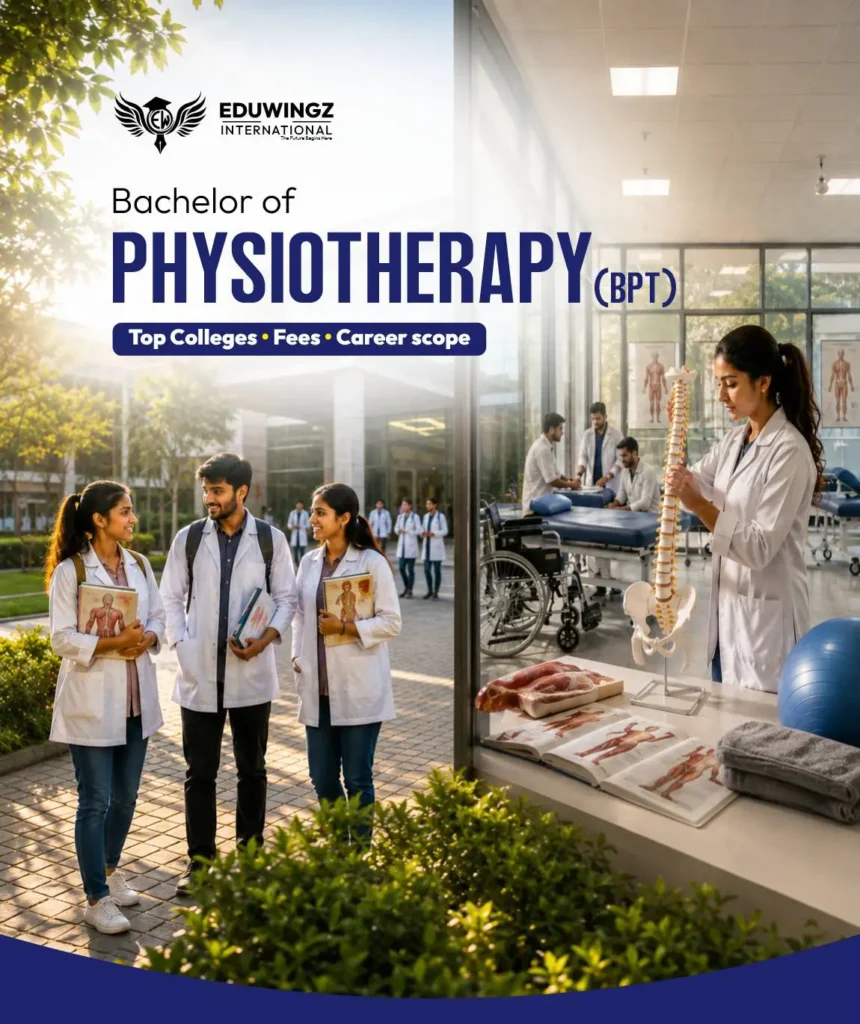
BPT stands for Bachelor of Physiotherapy. It is a full-time undergraduate degree in physiotherapy, regulated in India by the National Commission for Allied and Healthcare Professions (NCAHP). The programme is four and a half years long, including a mandatory six-month rotating clinical internship.
Physiotherapy is the branch of healthcare that treats movement dysfunction caused by injury, neurological conditions, musculoskeletal disorders, cardiopulmonary disease, sports injuries, and post-surgical recovery. BPT graduates are trained to assess patients, design rehabilitation programmes, and use physical modalities to restore function and reduce pain.
BPT is not MBBS. It is an independent clinical healthcare profession with its own scope of practice, licensing body, and postgraduate pathway. Graduates are registered practitioners under NCAHP and can practise independently as physiotherapists.
BPT at a Glance
Parameter | Details |
Full Name | Bachelor of Physiotherapy |
Duration | 4.5 years (4 years academic + 6 months compulsory internship) |
Governing Body | National Commission for Allied and Healthcare Professions (NCAHP) |
Entrance Exam (Govt. Seats) | NEET UG (mandatory) |
Private College Admission | Many accept students without NEET through direct admission |
Total Seats in India (Approx.) | 30,000+ across government, private, and deemed institutions |
NEET Qualifying Percentile | 50th percentile for General; 40th for SC/ST/OBC |
Government College Fees (Approx.) | Rs. 20,000 to Rs. 80,000 per year |
Private College Fees (Approx.) | Rs. 80,000 to Rs. 3 lakhs per year |
Postgraduate Option | MPT (Master of Physiotherapy) — 2 years |
Starting Salary in India (Approx.) | Rs. 2.5 to Rs. 6 lakhs per year depending on employer and location |
BPT Eligibility Criteria in India
Academic Eligibility
- Passed Class 12 (10+2) from a recognised board
- Compulsory subjects: Physics, Chemistry, and Biology (PCB)
- Minimum aggregate in PCB: 50% for General and EWS category
- Minimum aggregate in PCB: 45% for SC, ST, and OBC candidates
- English as a subject in Class 12 is mandatory
Age Requirement
- Minimum age: 17 years as on December 31 of the admission year
- No upper age limit as per current regulatory guidelines
NEET Requirement
NEET UG qualification is mandatory for admission to government BPT seats in India through state counselling. Several private BPT colleges across India offer direct admission without NEET for students who meet the academic eligibility. Management quota seats at private institutions are generally available through direct institutional admission regardless of NEET score.
Important: A student who did not qualify NEET can still pursue BPT through direct admission at a private college. However, they cannot claim state quota or government college seats without a valid NEET score and qualifying percentile.
BPT Course Syllabus in India
The BPT curriculum is divided across four academic years followed by a six-month compulsory internship. It combines theoretical study with progressive clinical exposure, ensuring graduates are workplace-ready.
Year 1 – Basic Sciences
- Anatomy (General and Applied)
- Physiology
- Biochemistry
- Introduction to Physiotherapy and its History
- Psychology in Healthcare
Year 2 – Pre-Clinical Sciences
- Pathology and Microbiology
- Pharmacology
- Biomechanics and Kinesiology
- Exercise Therapy
- Electrotherapy
Year 3 – Clinical Sciences
- Orthopaedic Physiotherapy
- Neurological Physiotherapy
- Medical Conditions and Physiotherapy
- Paediatric Physiotherapy
- Supervised Clinical Posting
Year 4 – Advanced Clinical Practice
- Cardiopulmonary Physiotherapy
- Sports Physiotherapy
- Community Rehabilitation
- Geriatric Physiotherapy
- Research Methodology and Evidence-Based Practice
- Intensive Clinical Rotations
Internship (6 Months)
The compulsory six-month rotating internship is completed at a hospital or clinical facility affiliated to the BPT college. Students rotate through orthopaedics, neurology, paediatrics, cardiopulmonary, and sports physiotherapy departments under supervision.
Specialisation Areas in BPT
While the BPT degree is a general physiotherapy qualification, students develop interest areas during clinical rotations that often shape their postgraduate specialisation or early career direction. Recognised areas of specialisation include:
- Orthopaedic and Musculoskeletal Physiotherapy
- Neurological Physiotherapy (stroke, Parkinson’s disease, spinal cord injury)
- Paediatric Physiotherapy (cerebral palsy, developmental delays)
- Sports and Exercise Physiotherapy
- Cardiopulmonary Physiotherapy (cardiac rehabilitation, COPD management)
- Obstetrics and Women’s Health Physiotherapy
- Geriatric Rehabilitation
- Community-Based Rehabilitation
BPT Fees in India
Fees vary considerably based on whether you are in a government, private, or deemed institution. Below are approximate fee ranges across institution types.
College Type | Annual Tuition Fees (Approx.) | Total Course Fees (4.5 yrs) |
Government / State BPT Colleges | Rs. 20,000 to Rs. 80,000 | Rs. 90,000 to Rs. 3.6 lakhs |
Private BPT Colleges | Rs. 80,000 to Rs. 2.5 lakhs | Rs. 3.6 to Rs. 11.25 lakhs |
Deemed Universities | Rs. 1.5 to Rs. 3.5 lakhs | Rs. 6.75 to Rs. 15.75 lakhs |
Management Quota (Private) | Rs. 2 to Rs. 4 lakhs | Rs. 9 to Rs. 18 lakhs |
Fees listed above are approximate. State fee regulatory committees periodically revise fee caps for private and deemed institutions. Hostel and mess charges are additional and typically range from Rs. 70,000 to Rs. 1.5 lakhs per year.
Students can apply to banks for education loans. Most banks offer unsecured education loans up to Rs. 7.5 lakhs for BPT. Amount above Rs. 7.5 lakhs requires collateral. Repayment begins six months after completion of the course.
NEET Cut-off for BPT Admission in India
The NEET cut-off for BPT admission is the minimum score and rank required to be considered for government college seat allotment through state paramedical counselling. Cut-offs vary by state, category, and institution type.
Seat Type | General Category (Approx.) | OBC (Approx.) | SC/ST (Approx.) |
Government BPT Colleges | 380 to 500 marks | 300 to 400 marks | 250 to 340 marks |
Private BPT Colleges | 250 to 380 marks | 200 to 320 marks | 180 to 280 marks |
Management Quota (Private) | 200 to 350 marks | 180 to 280 marks | 150 to 250 marks |
Note: These are approximate NEET score ranges based on recent counselling trends. Actual cut-offs change each year based on the number of applicants, total seats, and NEET paper difficulty. Students with scores below 300 should explore private college direct admission options. |
Top BPT Colleges in India
India has over 600 NCAHP-approved BPT colleges spread across all major states. The quality of education, hospital affiliation for internship, faculty credentials, and clinical infrastructure varies significantly. Below are some of the well-regarded institutions across government and private categories.
College Name | Location | Type | Approx. Annual Fees |
AIIMS New Delhi (Allied Health Sciences) | New Delhi | Government (Central) | Rs. 25,000 to Rs. 50,000 |
Christian Medical College (CMC) | Vellore, Tamil Nadu | Private Aided | Rs. 60,000 to Rs. 1.2 lakhs |
Manipal College of Health Professions | Manipal, Karnataka | Deemed | Rs. 2 to Rs. 3.5 lakhs |
Sri Ramachandra Institute (SRIHER) | Chennai, Tamil Nadu | Deemed | Rs. 1.5 to Rs. 2.5 lakhs |
M.S. Ramaiah College of Physiotherapy | Bangalore, Karnataka | Private Deemed | Rs. 1.5 to Rs. 2 lakhs |
Jamia Hamdard | New Delhi | Deemed | Rs. 1.2 to Rs. 2 lakhs |
Kasturba Medical College (KMC) | Mangalore, Karnataka | Deemed | Rs. 1.5 to Rs. 2.5 lakhs |
RV College of Physiotherapy | Bangalore, Karnataka | Private | Rs. 90,000 to Rs. 1.5 lakhs |
JSS College of Physiotherapy | Mysore, Karnataka | Private | Rs. 80,000 to Rs. 1.5 lakhs |
Maharishi Markandeshwar University | Ambala, Haryana | Deemed | Rs. 1.2 to Rs. 2 lakhs |
NIMS University | Jaipur, Rajasthan | Private Deemed | Rs. 1 to Rs. 2 lakhs |
Sikkim Manipal University | Gangtok, Sikkim | Deemed | Rs. 1 to Rs. 1.8 lakhs |
When evaluating a BPT college, look beyond the fee structure. Key factors include NCAHP approval status, the hospital with which the college is affiliated for clinical training, year-wise patient exposure, faculty qualifications, infrastructure for electrotherapy and rehabilitation labs, and the alumni record in government job exams and private placement.
BPT Admission Process in India
BPT admissions follow two parallel tracks depending on whether you are pursuing government or private seats.
For Government and Government-Aided Seats
- Qualify NEET UG with minimum eligibility percentile (50th for General, 40th for SC/ST/OBC).
- Register on the relevant state paramedical counselling portal. Each state conducts separate BPT seat allotment.
- Upload required documents: NEET scorecard, Class 10 and Class 12 mark sheets and certificates, domicile certificate, category certificate if applicable, and passport-size photographs.
- Fill college and course preferences in the portal in strategic priority order.
- Attend seat allotment rounds. Multiple rounds are typically conducted for unfilled seats.
- Accept the allotment, pay the seat fee, and report to the allotted college with original documents within the stipulated deadline.
For Private College Direct Admission
- Contact the institution directly or through a consultant to confirm seat availability for the current academic year.
- Confirm the exact fee structure including tuition, development charges, hostel, and other components.
- Submit the application along with Class 12 mark sheets, NEET scorecard (if available), transfer certificate, and other required documents.
- Pay the initial admission fee and secure the seat.
- Complete the remaining documentation and attend the orientation process as directed by the college.
Pro Tip: Government seat counselling and private direct admission windows often overlap. Missing a private college deadline while waiting for government allotment results is one of the most common and costly mistakes in BPT admissions. Having a consultant track both simultaneously reduces this risk significantly. |
BPT Career Scope in India
BPT graduates have a genuinely broad career landscape in India, spanning clinical practice, government service, sports, academia, and entrepreneurship. The physiotherapy profession in India is growing substantially, supported by a rising patient population requiring rehabilitation and increasing awareness of physical medicine.
Clinical and Hospital Careers
- Physiotherapist in government district and tertiary hospitals
- Physiotherapist in private multi-specialty hospitals and rehabilitation centres
- Home-visit and telemedicine physiotherapist
- Physiotherapy team member in corporate wellness programmes
Sports and Fitness
- Team physiotherapist for state or national sports teams
- Sports physiotherapist at cricket academies, football clubs, and athletic federations
- Fitness centre consultant and injury prevention specialist
Government Jobs
- UPSC Combined Medical Services (select posts open to NCAHP-registered practitioners)
- State public service commission AYUSH and paramedical officer exams
- National Health Mission (NHM) physiotherapist positions at district and community health centres
- Railways, defence, and ESIC Physiotherapist vacancies
Independent Practice
- Open a physiotherapy clinic in your city or locality
- Tele-rehabilitation consultancy for urban and rural patients
- Home care physiotherapy practice
Postgraduate and Academic Careers
- Pursue MPT (Master of Physiotherapy) in orthopaedics, neurology, sports, or cardiopulmonary specialisation
- PhD in Physiotherapy for research and academic positions
- Teaching faculty at BPT colleges after completing MPT
BPT Salary in India
Role / Setting | Starting Salary (Approx. Per Year) | Experienced Salary (Approx. Per Year) |
Government Hospital Physiotherapist | Rs. 3 to Rs. 5 lakhs | Rs. 6 to Rs. 12 lakhs |
Private Hospital Physiotherapist | Rs. 2.5 to Rs. 4.5 lakhs | Rs. 5 to Rs. 10 lakhs |
Sports Physiotherapist | Rs. 3.5 to Rs. 6 lakhs | Rs. 8 to Rs. 18 lakhs |
Corporate Wellness Physiotherapist | Rs. 3 to Rs. 5 lakhs | Rs. 6 to Rs. 12 lakhs |
Independent Private Practice (Clinic) | Rs. 3 to Rs. 5 lakhs (early years) | Rs. 8 to Rs. 25 lakhs (established) |
Read our complete guide: BPT career scope, salary benchmarks, and postgraduate options in India. Visit: /blog/bpt-career-scope-india |
BPT vs MPT - What Comes After BPT?
After completing BPT, graduates who want to specialise or enter academic and research careers pursue MPT (Master of Physiotherapy), which is a two-year postgraduate degree.
Parameter | BPT | MPT |
Duration | 4.5 years | 2 years |
Level | Undergraduate | Postgraduate |
Entrance | NEET UG (govt.) or direct (private) | State counselling or institution-specific exam |
Scope | General physiotherapy practice | Specialised clinical practice, academia, research |
Specialisations | Not applicable | Orthopaedics, Neurology, Sports, Paediatrics, Cardiopulmonary |
Eligibility | Class 12 PCB | BPT with minimum 50% marks |
MPT significantly improves career prospects and salary potential, especially in hospital leadership roles, academic positions, and specialised sports or neurological rehabilitation. Students planning to enter government service or research are strongly advised to pursue MPT after BPT.
How Eduwingz Helps You with BPT Admission
Eduwingz International is a trusted education consultancy based in Bangalore and Kolkata, specialising in medical and paramedical admissions including BPT. Here is how our team supports students and parents through the BPT admission process:
Objective Assessment of Your Options
We begin with an honest review of your NEET score, academic background, budget, and preferred location to give you a realistic picture of the BPT seats available to you across government, private, and management quota tracks.
Career Counselling Before Admission
We provide complete career guidance before you commit to a college or course. This includes realistic salary benchmarks, postgraduate pathways, government job opportunities, and a clear picture of what a BPT career looks like in practice. Students who understand the full career path make better admission decisions.
State-Wise Counselling Guidance
Each state runs its own paramedical counselling process with separate portals, schedules, and documentation requirements. We track these simultaneously and guide you through registration, document preparation, choice filling, and allotment across multiple states where you may be eligible.
Private and Management Quota Direct Admission
For students seeking direct BPT admission at private colleges, we have established contacts with institutions across Karnataka, Tamil Nadu, Maharashtra, Andhra Pradesh, and other states. We verify seat availability, confirm the true fee structure, and facilitate the admission process without hidden charges.
Get Free BPT Admission Counselling - Talk to an Expert Today
Book your free counselling session today. No fees. No pressure. Just clarity.
- Services request
Get 1 on 1 Counselling
Expert guidance for your education journey
Frequently Asked Questions - BPT in India
BPT is a four-and-a-half-year undergraduate programme. This includes four years of academic study across eight semesters and a mandatory six-month rotating clinical internship at a hospital or clinical facility affiliated to the college. The degree is awarded after successful completion of both components.
NEET UG is mandatory for admission to government and government-aided BPT seats in India. Private BPT colleges typically offer direct admission for management quota seats without requiring NEET, as long as students meet the academic eligibility of 50% in Class 12 PCB. Some private institutions do require NEET qualification even for their own seats, so always verify with the specific college.
Government college fees for BPT typically range from Rs. 20,000 to Rs. 80,000 per year. Private college fees range from Rs. 80,000 to Rs. 2.5 lakhs per year. Deemed university fees fall between Rs. 1.5 and Rs. 3.5 lakhs per year. Management quota fees at private colleges are typically Rs. 2 to Rs. 4 lakhs per year. Total course cost for four and a half years ranges from approximately Rs. 90,000 in government colleges to Rs. 18 lakhs for management quota private seats.
For government BPT colleges, General category students typically need NEET scores between 380 and 500 marks, though this varies by state. Private colleges generally admit students with scores from 250 onwards. Management quota seats at private institutions may be available even with scores below 250. The NEET qualifying cut-off is the 50th percentile for General category and the 40th percentile for SC, ST, and OBC.
The BPT syllabus covers basic sciences in year one (Anatomy, Physiology, Biochemistry), pre-clinical sciences in year two (Biomechanics, Kinesiology, Exercise Therapy, Electrotherapy), clinical sciences in year three (Orthopaedic, Neurological, and Paediatric Physiotherapy), and advanced clinical practice in year four (Sports, Cardiopulmonary, Community and Geriatric Physiotherapy, Research Methodology). This is followed by a six-month clinical internship.
BPT graduates can work in government hospitals, private multi-specialty hospitals, sports academies, rehabilitation centres, and corporate wellness programmes. Independent private practice is common in urban areas. Government jobs are available through UPSC, state PSC, NHM, Railways, ESIC, and defence physiotherapist vacancies. Postgraduate specialisation through MPT opens academic and research careers. Starting salaries range from Rs. 2.5 to Rs. 5 lakhs per year, with significant growth over experience.
MBBS is a five-and-a-half-year degree that trains general medical practitioners with the ability to prescribe medicines, perform surgeries, and diagnose any medical condition. BPT is a four-and-a-half-year degree specifically focused on physical rehabilitation and movement disorders using non-pharmacological methods. Physiotherapists cannot prescribe medicines. They practise an independent, complementary clinical profession. BPT is significantly more affordable and has a shorter training period.
Yes. Many private BPT colleges across India offer direct admission for management quota seats without requiring NEET qualification, provided students have passed Class 12 with a minimum of 50% in PCB subjects. The number of seats available through this route and the associated fees vary by institution. A consultant can help you identify which colleges have genuine NCAHP approval and available management quota seats.
MPT stands for Master of Physiotherapy. It is a two-year postgraduate specialisation programme that BPT graduates can pursue after completing the undergraduate degree. MPT allows graduates to specialise in areas such as orthopaedics, neurology, sports, paediatrics, or cardiopulmonary physiotherapy. It significantly improves career prospects, salary, and eligibility for academic and research positions. BPT is the prerequisite for MPT.
Yes. The demand for physiotherapists in India is growing across multiple sectors including hospitals, sports, corporate wellness, and home care. The government has recognised physiotherapy as an essential healthcare profession under the NCAHP framework. Growing awareness of rehabilitation, an ageing population, increasing sports injuries, and post-COVID care requirements are all driving demand. Specialisation through MPT and focused skill-building can significantly accelerate career growth.
Karnataka, Tamil Nadu, Maharashtra, Kerala, and Delhi are among the strongest states for BPT education in terms of the number of NCAHP-approved colleges, clinical infrastructure, hospital affiliation quality, and career opportunities post-graduation. Karnataka in particular has a strong cluster of BPT colleges in Bangalore, Mysore, and Mangalore with reputed hospital attachments.
Key criteria for choosing a BPT college include: NCAHP approval status, the hospital with which the college is affiliated for internship training, quality of electrotherapy and rehabilitation labs, faculty qualifications, past student placement records, state recognition for government job eligibility, and the true total fee over four and a half years including all charges. Speaking with current students or alumni and working with an experienced admission consultant can help you avoid colleges with poor clinical infrastructure despite reasonable fees.